The Plane With a Twisty Wing
NASA’s Ames-Dryden AD-1 wore one long wing on a pin. Takeoff looked ordinary. Then the wing twisted — one tip forward, one tip back — up to 60 degrees. Seventy-nine flights. Then a museum.
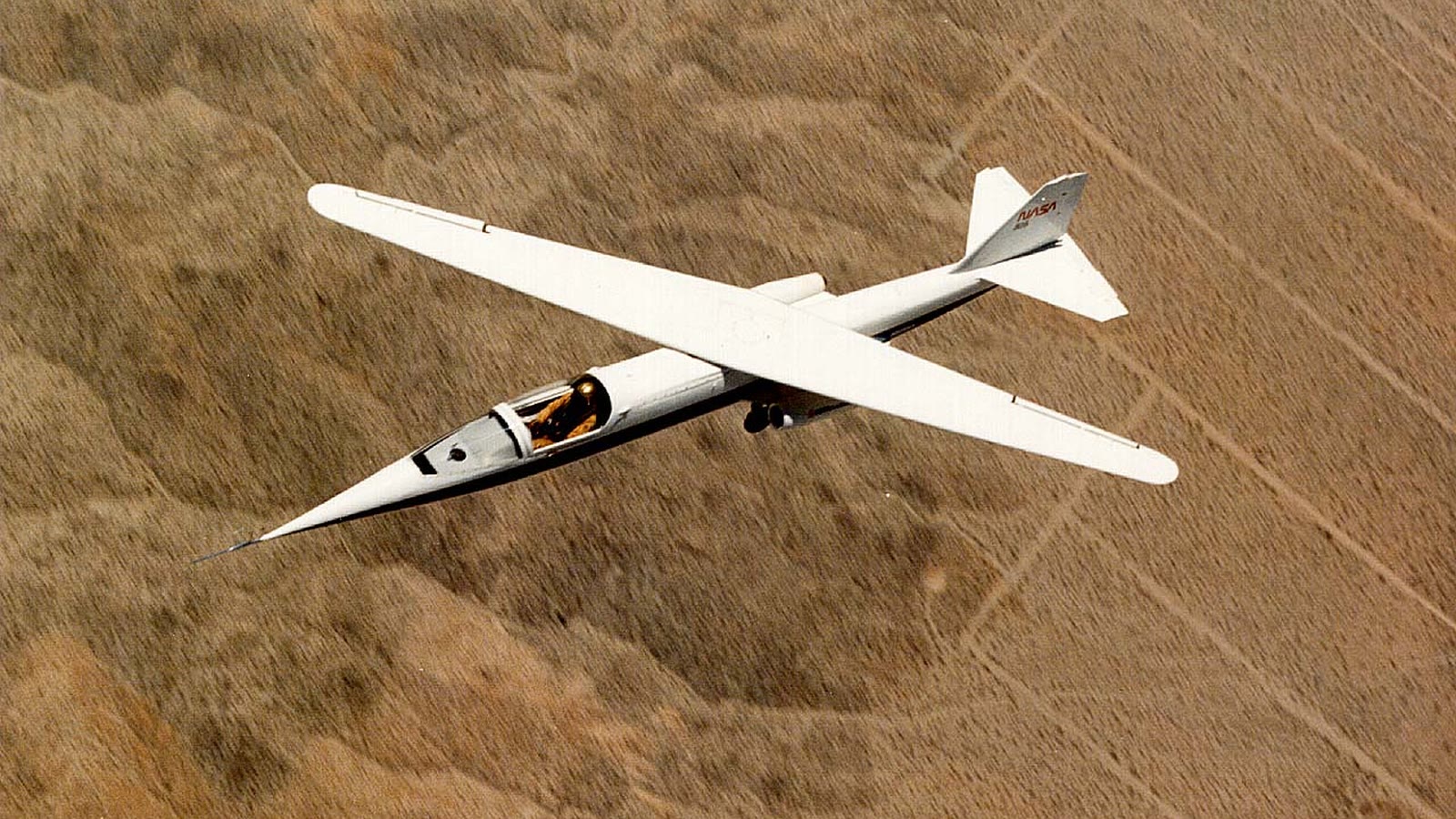
One wing. One pin. A clock-hand turn.
Most airplanes wear two matching wings that stay put. The Ames-Dryden AD-1 wore one long wing on a pin through the middle. On the runway the wing sat straight across, like any ordinary airplane. In the air the whole thing could twist — one tip sliding forward, the other sliding back — until the wing looked like a clock hand stuck on a slant.
Engineers call that an oblique wing. Not a swing-wing that tucks both tips backward. This wing could only go one way: right tip forward.
Wingman Levi, six, said it looked like someone parked a dart crooked on purpose. Captain Jacob, ten, wrote OBLIQUE = SLANTED on the board and made everyone say it once.
The idea came from Robert T. Jones at NASA Ames, Moffett Field, California. His wind-tunnel work said a big airliner with a slanted wing, flying up to about Mach 1.4, might sip far less fuel than a regular wing — Ames even talked about twice the fuel economy. The AD-1 was the small, slow homework plane. It would not race the Atlantic. It would answer a simpler question: can a pilot fly the slant?
A cheap jet with twisty homework
NASA named it Ames-Dryden-1. Ames dreamed the shape. Dryden — today’s Armstrong Flight Research Center — flew it over the desert at Edwards, California.
Boeing sketched the geometry. The Rutan Aircraft Factory in Mojave did the detailed design and the loads math. Ames Industrial Co. in Bohemia, New York, built the real airplane for $240,000. Plastic reinforced with fiberglass. Empty weight 1,450 pounds. Length 38.8 feet. Height 6.75 feet. Wingspan 32.3 feet when the wing sat straight. Two little turbojets, 220 pounds of thrust each. Fixed wheels that made it look squat on the ground. Safety cap: 170 miles per hour. This was not a racer. It was a question with engines.
It arrived at Dryden in March 1979. First flight: 21 December 1979. NASA research pilot Thomas C. McMurtry. Wing still straight. They added slant a little at a time — 15 degrees, then 20, then 45. On 24 April 1981 they hit the 60-degree goal. McMurtry also flew the last research flight, 7 August 1982. Total: 79 flights.
Above about 45 degrees the cheap fiberglass wing got bendy, and the airplane mixed pitch with roll, so the stick felt messy. NASA wrote that down as expected. The structure finished the homework. It did not finish the dream of a fast slant-wing airliner.
What the hangar keeps
The AD-1 did not become a passenger jet. Nobody tickets you on a clock-hand wing today. What it proved is simpler: a piloted airplane can take off with a straight wing, twist that wing in flight, and land again. Jones still liked the idea for long ocean hops. The next airplane would have needed a stiffer wing and better computers. That next airplane did not get built as a passenger ship.
The real AD-1 now sits at the Hiller Aviation Museum in San Carlos, California. You can walk up and see the pin.
Co-Pilot Isaac, eight, wanted to know if you could twist only halfway and call it good. Captain said halfway is 30 degrees and NASA flew lots of angles. The photo is the full 60. Crooked on purpose is the point.
Try this: straight Dart vs clock-hand Dart
Fold The Dart the usual way. Fly it once down the hallway. Notice how both wings match.
Now fold a second Dart and cheat the wing: slide one side a little forward and the other a little back before you tape the middle, or pinch the paper so the whole wing sits on a slant like a clock hand. Same throw. Same hallway.
The straight Dart tracks. The slanted one may roll or dive. That is the AD-1 lesson without a desert: a crooked wing changes how air pushes. NASA spent 79 flights learning to live with that push. If your slanted Dart snaps into a spiral, flatten the wing a bit and try a small slant first, the way Dryden started at 15 degrees.
Do not throw at faces. The brothers only approve hallway tests.
Source note
NASA Ames-Dryden-1 (AD-1) oblique-wing research aircraft; Robert T. Jones, Ames (Moffett Field) concept / wind-tunnel work (transport-size oblique wing to ~Mach 1.4; Ames cited possible ~2× fuel economy vs conventional); Boeing geometric configuration; Rutan Aircraft Factory (Mojave) detailed design and loads; Ames Industrial Co. (Bohemia, NY) built it under $240,000 fixed-price contract; fiberglass-reinforced plastic; empty 1,450 lb; 38.8 ft long; 6.75 ft high; 32.3 ft span unswept; two turbojets, 220 lbf each; limited to 170 mph for safety; delivered Dryden March 1979; first flight 21 December 1979 (Thomas C. McMurtry, wing 0°); 60° design goal 24 April 1981; last flight 7 August 1982 (McMurtry); 79 flights; poor handling above ~45° (aeroelastic + pitch-roll coupling; fiberglass limited stiffness); wing pivoted 0–60°, right tip forward; preserved at Hiller Aviation Museum, San Carlos, CA. Photo: NASA Dryden ECN-15846, public domain, Wikimedia Commons (File:AD-1_ObliqueWing_60deg_19800701.jpg).
Crew note
Captain will not let anyone say “both wings swept back” — that is a different trick. Co-Pilot keeps drawing a clock and labeling the hand “60°.” Wingman named the paper one Crooked Dart 805, which is the NASA number plus the correct insult.