The Plane With Almost No Wings
NASA’s Northrop HL-10 made lift with a fat silver body instead of ordinary wings. A B-52 dropped it 37 times. It hit Mach 1.86 — then the Space Shuttle still chose real wings.
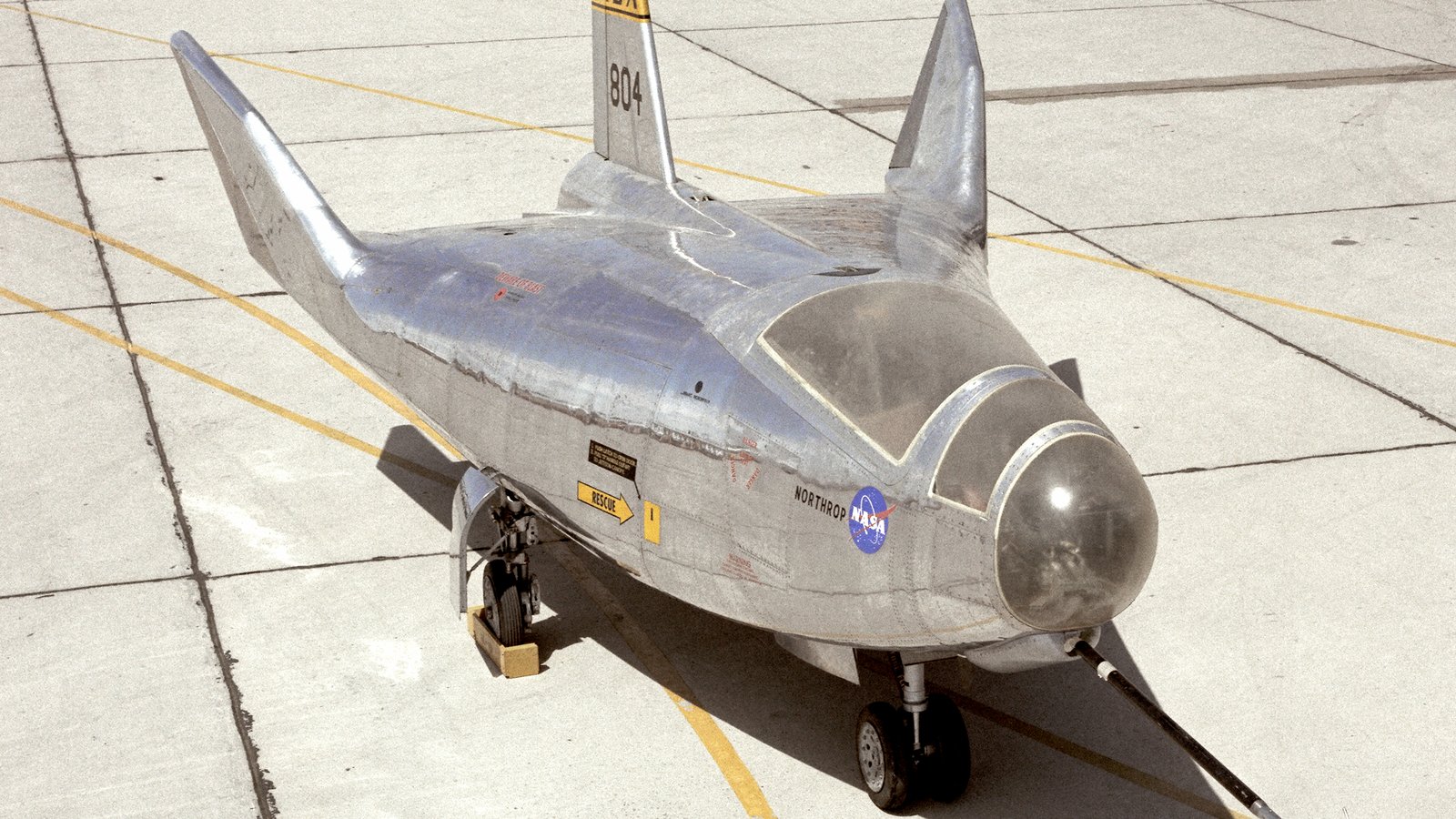
Almost no wings. Still a plane.
Most airplanes wear long wings like arms. The Northrop HL-10 wore a fat silver body and a few fins. The body was the wing.
NASA wanted a straight answer: if a spacecraft comes home from high up, can it glide and land on a dry lake like an airplane even when it does not have ordinary wings? In the 1960s that was still homework, not a museum label. Engineers called the idea a lifting body — lift from the shape of the fuselage, not from a separate pair of wings.
HL stands for horizontal landing. The 10 means it was the tenth lifting-body shape Langley engineers studied. Northrop built the one NASA flew. One airplane. Not a fleet.
Wingman Levi, six, said it looked like a tadpole that learned to sit on a nose wheel. Captain Jacob, ten, wrote BODY = WING on the board and underlined the equals sign so nobody called the photo a broken jet.
Drop, burn, glide, lakebed
A modified B-52 mothership carried the HL-10 under its wing, climbed to about 45,000 feet, and dropped it at about 450 miles per hour. The first 11 flights were unpowered glides, just to see if the fat shape would behave. Pilot Bruce Peterson flew the first one on 22 December 1966.
The rocket came later. The engine was an XLR-11 — the same family of rocket that shoved the Bell X-1 through the sound barrier. About 100 seconds of burn. Then the pilot had to steer a steep, fast glide onto Rogers Dry Lake at Edwards, California. Low lift-over-drag means you do not float like The Cloud Glider. You come in steep and you land hot.
First powered flight: 23 October 1968.
First lifting body to go faster than sound: 9 May 1969, John Manke.
Fastest: 18 February 1970, Air Force Major Peter Hoag, Mach 1.86 — 1,228 miles per hour.
Highest: 27 February 1970, NASA’s Bill Dana, about 90,000 feet.
Last flight: 17 July 1970.
Total: 37 flights.
NASA judged the HL-10 the best-handling of the first three heavyweight lifting bodies — the M2-F2/F3, the HL-10, and the X-24A. That is a hangar compliment: the weird one that still answered the stick.
What it did not become
It did not go to space. It did not become the Space Shuttle. The Shuttle used a different shape with real delta wings, because a fat body is hard to fly slowly and it lands very fast.
What the HL-10 did do was help NASA trust an unpowered landing. You do not need jet engines just to come home if the shape can glide. The hangar keeps that sentence and throws away the cartoon that says “this is the Shuttle’s dad.” Cousin, maybe. Parent, no.
The real airplane still sits on a pylon at the gate of NASA Armstrong Flight Research Center — the old Dryden — at Edwards. You can walk up and see the missing wings for yourself.
Co-Pilot Isaac, eight, wanted to know if those upturned tips at the back count as wings. Captain says they are fins and the trailing edge of the body. Almost no wings is the honest phrase. No wings at all is a lie.
Try this: body-wing vs arm-wings
Fold a normal paper dart with long wing creases. Fly it once down the hallway.
Now fold a second “HL-10”: a fat paper wedge or a short tube with only tiny fins at the back — no long wings. Tape the nose a little heavy. Throw both from the same spot.
The dart floats. The fat one dives sooner. That is the lifting-body lesson in the hallway: the body can make lift, but not as much as long wings, so the real HL-10 came in steep and fast. If your fat dart tumbles, add a little up-fold on the back fins, the way NASA kept adding control until the shape behaved.
Do not tape bottle rockets to a paper tadpole. The brothers only approve hallway drops.
Source note
Northrop HL-10 NASA lifting body; HL = horizontal landing, 10 = tenth Langley shape; delivered January 1966; first flight 22 December 1966 (Bruce Peterson, unpowered); first 11 flights glide from B-52; XLR-11 rocket; first powered 23 October 1968; first lifting-body supersonic 9 May 1969 (John Manke); 37 flights; Peter Hoag 18 February 1970 Mach 1.86 / 1,228 mph; Bill Dana 27 February 1970 ~90,030 ft (some Dryden sheets list 90,303); last flight 17 July 1970; judged best-handling of original heavyweight trio (M2-F2/F3, HL-10, X-24A); typical drop ~45,000 ft / ~450 mph; ~100 s burn; steep lakebed landing (low L/D); preserved at NASA Armstrong (Dryden) gate, Edwards AFB. Photo: NASA Armstrong Flight Research Center ECN-1289, public domain, Wikimedia Commons.
Crew note
Captain will not let anyone say “no wings at all” — the fins count, and the body is the wing. Co-Pilot keeps drawing it next to a dart and labeling the dart “cheater wings.” Wingman named the paper one Tadpole 804, which is the NASA number plus the correct animal.