The Plane That Folded Its Wingtips
North American’s XB-70 Valkyrie was a Mach 3 bomber that never became a bomber. At speed it folded its wingtips down — about 65 degrees — and rode its own shock wave. Six engines. Two jets. One museum.
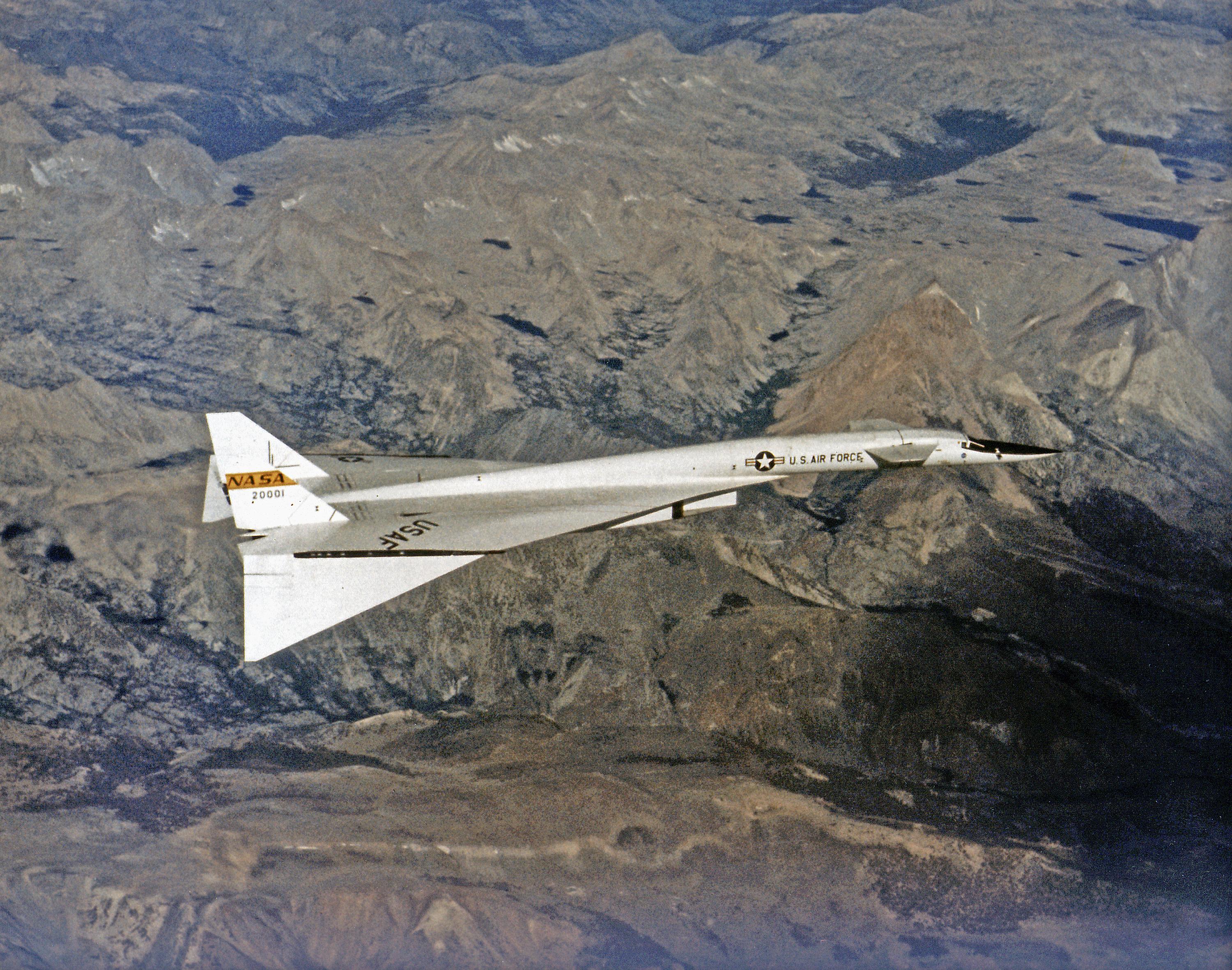
Wingtips that fold down on purpose.
Most wings stay put. The North American XB-70 Valkyrie cheated. On takeoff the outer panels sat flat, like any big delta. Once it was faster than sound, those tips folded down — about 65 degrees — until the airplane looked like a paper dart someone had creased at the ends.
NASA wrote the reason like a surf lesson. At Mach 3 the Valkyrie was built to ride its own shock wave, the way a board rides a swell. Folding the tips helped it sit on that wave, cut drag, and stay pointed. Engineers call the extra lift from the wave compression lift. The hangar calls it surfing on a wave you made yourself.
Six engines lived in a box under the wing. The paint was white. Behind the cockpit sat two canards — little wings that did most of the pitch work. The rest of the machine was a long white spear with a huge triangle at the back.
Wingman Levi, six, said it looked like a dart that learned to fold its own tips. Captain Jacob, ten, wrote 65° DOWN on the board and made everyone look at the photo until they saw the droop.
Two jets. Never a bomber.
North American built two XB-70As. A third was never finished. The Air Force had wanted a high, fast bomber. Missiles and cheaper rockets arrived first. The bomber program was canceled in 1961, before either airplane flew. What got built was homework: two research jets for big Mach 3 flight.
No. 1 — AV-1, serial 62-0001 — first flew in September 1964, Palmdale to Edwards. It reached Mach 3 in October 1965. After that one fast run the shop limited it to about Mach 2.5. No. 2 first flew on 17 July 1965. NASA Ames wind-tunnel work had changed the wing a little. That second jet handled better. It hit Mach 3 on 3 January 1966. By June it had made nine Mach 3 flights.
The work lived at Edwards, California. The Air Force and NASA’s Flight Research Center — later Dryden, then Armstrong — flew it together.
What the hangar will not skip
On 8 June 1966 the second Valkyrie was flying in a photo formation when a NASA F-104 collided with it. The F-104 was lost. So was XB-70 No. 2. NASA research pilot Joe Walker and the Valkyrie’s copilot, Air Force Major Carl Cross, died. North American pilot Al White ejected and lived.
That is the honest hangar sentence. We do not turn it into a cartoon. Two people did not come home.
No. 1 kept flying. NASA used it to study the problems a future fast airliner would meet — heat, boom, how a giant jet behaves when it is faster than sound. Last research flight: 4 February 1969. Fitzhugh “Fitz” Fulton and Emil “Ted” Sturmthal flew it from Edwards to Wright-Patterson, Ohio, and parked it at the Air Force Museum.
NASA counted 83 flights on No. 1 and 46 on No. 2.
What the hangar keeps
The Valkyrie never dropped a bomb. Nobody tickets you on a folded-tip bomber today. What it left is quieter: proof that a giant airplane can ride a shock wave, fold its own wingtips in flight, and come home with numbers instead of guesses.
AV-1 still sits in the Research and Development Gallery at the National Museum of the United States Air Force in Dayton, Ohio. You can walk under the white wing and check the hinges.
Co-Pilot Isaac, eight, wanted to know if you could fold only one tip. Captain said both, together, on purpose. The photo is the full droop.
Try this: flat Dart vs folded-tip Dart
Fold The Dart the usual way. Fly it once down the hallway. Notice how both tips stay level.
Now fold a second Dart and cheat the tips: crease both outer ends down — a little first, then more — so the wing looks like the Valkyrie in the photo. Same throw. Same hallway.
The flat Dart tracks. The folded one may roll or dive. That is the XB-70 lesson without a desert: tipping the ends down changes how air pushes, and the real airplane only did the big fold when it was already going very fast. If your folded Dart snaps into a spiral, flatten the tips a bit and try a small droop first, the way the real jet kept the tips flat for takeoff.
Do not throw at faces. The brothers only approve hallway tests.
Source note
North American XB-70A Valkyrie; two built (AV-1 / 62-0001, AV-2); third not completed; planned Mach 3 high-altitude bomber, program canceled 1961 before first flight; remaining pair used as Air Force / NASA research jets at Edwards (NASA Flight Research Center, later Dryden / Armstrong); six General Electric YJ93 turbojets (~30,000 lbf each with afterburner); white paint; canards + delta wing; outer panels hinged down in high-speed flight (museum: as much as 65°) to ride the airplane’s own shock wave (compression lift); AV-1 first flight Sept 1964 Palmdale–Edwards, Mach 3 Oct 1965, then limited ~Mach 2.5; AV-2 first flight 17 July 1965, first Mach 3 on 3 Jan 1966, nine Mach 3 flights by June; midair with NASA F-104 on 8 June 1966 destroyed No. 2 — NASA pilot Joe Walker and XB-70 copilot Maj. Carl Cross killed; North American pilot Al White ejected; AV-1 last flight 4 Feb 1969 (Fitzhugh “Fitz” Fulton / Emil “Ted” Sturmthal) to Wright-Patterson / Air Force Museum; NASA: 83 flights / 160 h 16 min (No. 1), 46 flights / 92 h 22 min (No. 2); AV-1 preserved, Research and Development Gallery, National Museum of the U.S. Air Force, Dayton, OH. Photo: NASA Dryden/Armstrong EC68-2131, public domain, NASA, Wikimedia Commons (File:North_American_XB-70_in_Flight_EC68-2131.jpg). NASA FS-084-DFRC / XB-70 Valkyrie page; National Museum of the USAF XB-70 fact sheet.
Crew note
Captain will not let anyone say “the bomber that bombed.” It never did. Co-Pilot keeps folding paper tips toward 65° with a protractor and labeling the crease “on purpose.” Wingman named the paper one Droop Dart 0001, which is the serial on the white jet plus the correct insult.