The Pedal Plane That Crossed the Channel
On 12 June 1979 Bryan Allen pedaled a 70-pound Mylar airplane from England to France — no engine, just legs, a canard, and almost three hours of careful flying.
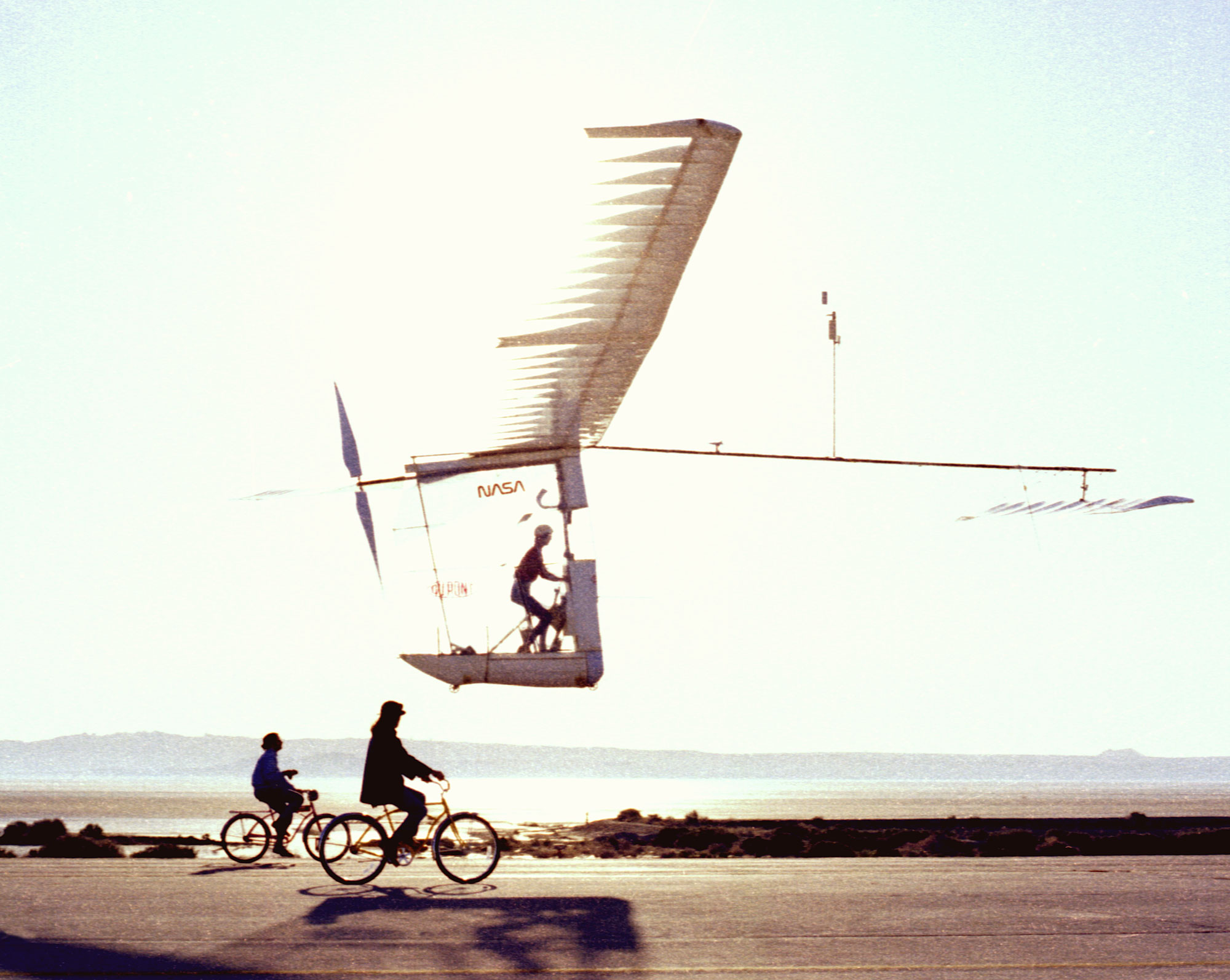
No engine. Just pedals.
Most airplanes hide a loud engine. The Gossamer Albatross hid a bicycle.
On 12 June 1979, cyclist and pilot Bryan Allen sat in a clear gondola under a wing longer than a school bus. He pedaled. A chain turned a big two-bladed propeller. The airplane — designed by Paul MacCready and the AeroVironment team — left a quay near Folkestone, England, and aimed for Cap Gris-Nez, France. No fuel tank. No roar. Just legs turning at about 75 revolutions per minute and a promise that light materials could do heavy history.
The Channel crossing took 2 hours and 49 minutes and covered about 22.5 miles (36.2 kilometers). It won the second Kremer Prize for human-powered flight. The hangar keeps that date in chalk because the story is not “magic.” It is mass, drag, and a person who refused to quit when the radio died and the water bottle ran dry.
Why a 70-pound wing works
Empty, the Albatross weighed about 70 pounds (31.8 kilograms). At takeoff, with Allen aboard, it was near 215 pounds (97.5 kilograms). Wingspan: 93 feet 10 inches (28.6 meters). Top speed hovered around 15 mph. Those numbers only work if the structure is almost nothing.
MacCready’s team used carbon-fiber tubing, polystyrene foam, Kevlar lines, and clear Mylar skin. The layout was a canard: a horizontal stabilizer ahead of the main wing, the same family of idea the Wright brothers trusted. Long, skinny wings gave a high aspect ratio — more lift for less drag when you are barely faster than a jog.
The flight was not a parade. Winds rose. Instruments starved as batteries faded. A chase boat moved in, ready to hook the plane if Allen had to abort. He climbed a little, found smoother air, and kept pedaling until French sand was under the skids.
NASA later flew the backup craft, Gossamer Albatross II, at Dryden for slow-speed research — human power, a tiny electric motor, and towed runs. The Channel airplane taught museums; those flights taught engineers how giant light wings behave when the air is almost still.
What the hangar keeps
Captain Jacob, ten, wrote “legs are the engine” on the board and underlined Kremer so nobody confuses prize with fuel. Co-Pilot Isaac, eight, measured the wingspan against the hangar wall with string. Wingman Levi, six, calls it the pedal bird, which is unfair to albatrosses and perfect for the photo.
The original Channel Albatross lives with the Smithsonian National Air and Space Museum. You can walk under clear Mylar and still believe a person crossed salt water by turning a crank. Weird engineering is still engineering when the stopwatch and the beach agree.
The hangar lesson is soft on glory and hard on materials. Cut weight, stretch span, keep the propeller honest, and a bicycle can finish a Channel crossing.
Try this: the canard paper bird
Fold a paper dart the usual way. Fly it once at a towel on the floor.
Now fold a second dart and add a small paper “nose wing” — a short strip taped ahead of the main wing, like a tiny front stabilizer. Throw both from the same spot. The canard dart often pitches differently. That is a rug version of why the Albatross put control out front.
Do not pedal a kite off a pier. Real Albatross flights had chase boats, test pilots, and museum paperwork. Yours stays indoors.
Source note
MacCready / AeroVironment Gossamer Albatross; Channel crossing 12 June 1979, Bryan Allen; Folkestone, England to Cap Gris-Nez, France; ~22.5 mi / 36.2 km in 2 h 49 min; second Kremer Prize; empty ~70 lb, takeoff ~215 lb; span 93 ft 10 in; carbon-fiber / Mylar canard; Albatross II NASA Dryden slow-speed tests (incl. ECN-12604); Channel aircraft preserved at Smithsonian NASM.
Crew note
Captain refuses to call it a toy bike with wings. Co-Pilot keeps asking how many water bottles fit in the gondola. Wingman wants a Mylar paper Albatross that spans the whole table, which is the assignment minus the Channel.